Pool renovation risk guide
Can an Empty Pool Pop Out of the Ground?
Plan relief, active dewatering, discharge and backup before the renovation removes the water holding the vessel down.
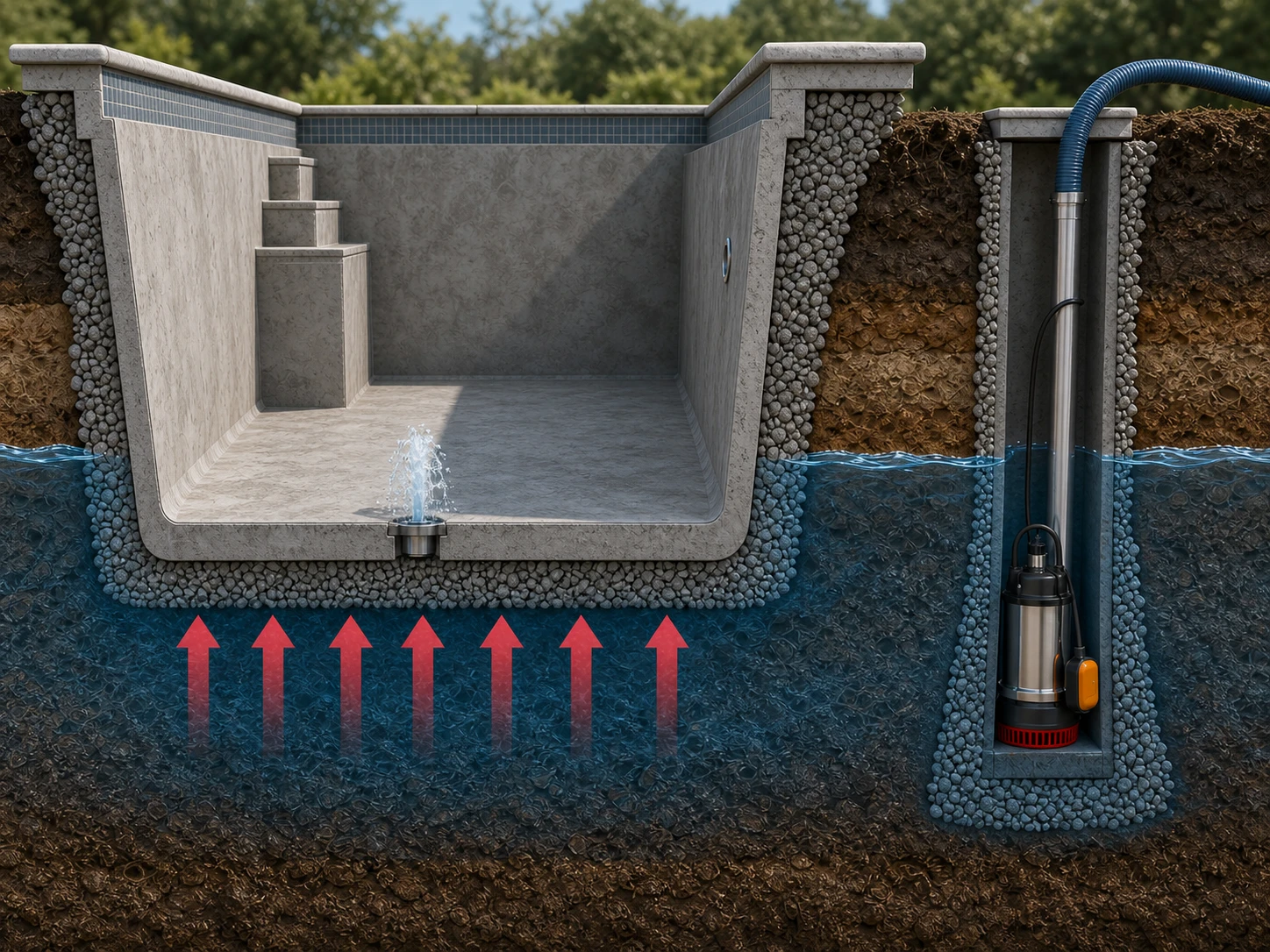
In a Florida court case, a small pool job scoped for surface cleaning, spot repairs and replacement of a handful of tiles became a major property loss. As the contractor drained the pool, water-table pressure caused the shell to pop, damaging the pool, pump, heating system, deck, screen enclosure, landscaping and sprinkler system. The project scope was small. The financial impact - $48,144.50 in 2001 - was anything but small.
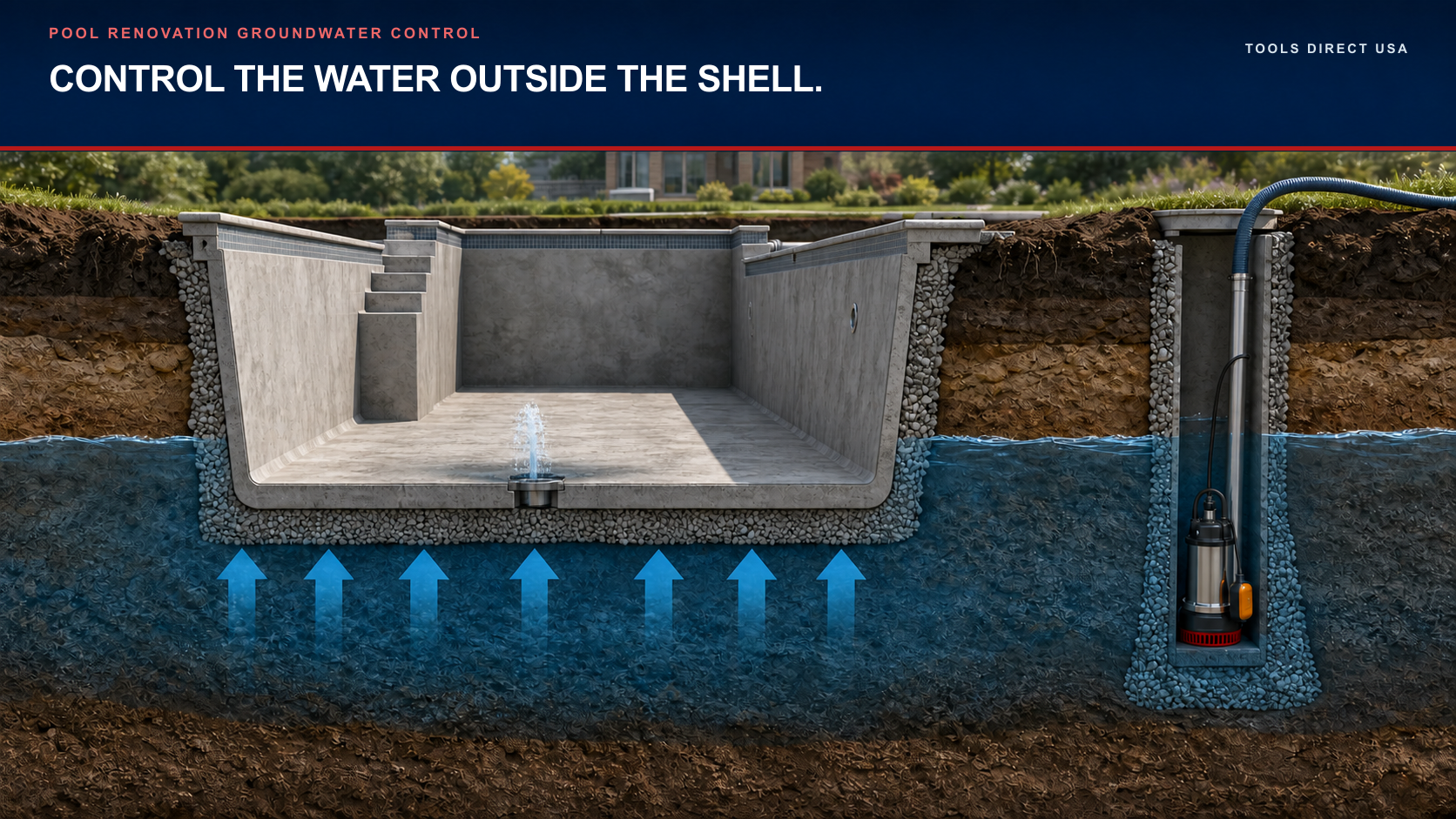
The lesson for a pool contractor is simple: a draining plan only moves the pool water, but a groundwater plan protects the shell, the schedule and the contractor. An inground pool can lift, shift, bulge or crack when water pressure outside the vessel exceeds the resistance provided by the pool water, shell, anchorage and surrounding structure. Before the water level drops, the company should know how outside water will be evaluated, where it can be relieved or pumped, where discharge is allowed, what happens if inflow increases and who is responsible for watching the system while the pool remains open.
Site history, shell type, weather, relief features and outside water elevation.
Do this before the water drops.Know what equalizes pressure and what actively lowers exterior water.
Do not confuse the two assignments.Inflow, lift, hose, solids, power, duty and legal discharge destination.
Outlet diameter is not pump sizing.Independent backup, monitoring, spare hose and a weather response.
Two pumps can still share one failure.The danger is differential head, not simply wet soil
Water presses in every direction. When a pool is full, the water inside the vessel helps resist pressure from groundwater outside it. Draining removes that internal ballast. If the exterior water level rises high enough relative to the water remaining inside, the resulting upward and inward forces can damage the vessel.
The industry often calls the failure a popped pool, floated shell or a pool that became a boat. Those phrases are useful because they describe the result plainly, but they can hide the condition that matters. The relevant question is not merely whether the yard looks wet. It is how high the water outside the vessel can rise, how quickly that condition can change and whether the relief or dewatering system can keep up.
AQUA Magazine's discussion of hydrostatic pressure uses the engineering term differential head for the difference between water levels inside and outside the structure. It also notes that groundwater problems are not confined to obvious wetlands. A pool at the bottom of a slope, water moving through subsurface bedding, irrigation, a broken water line or a major rain event can create a locally high condition even when the regional water table is normally lower.
This is why a weather forecast is part of the production plan. A site that was manageable on drain day can become a different site after overnight rain or runoff from neighboring property. Leaving some water in the deep end may add ballast, but it is not a substitute for evaluating the actual site and vessel.
Once a shell has lifted, adding water does not reliably return the pool to its previous position. Plumbing, decks, bond beams and finishes may already have moved or fractured. The loss is not limited to the surface being renovated.
Three documented pool-uplift cases
No published example supplies a universal failure threshold. Together, however, these records show how a small renovation, a rain event and a dewatering shutdown can each expose a pool to damaging uplift.
A few repairs became a pool-and-property loss
In American Equity Insurance Co. v. Van Ginhoven, the trial judge found that the contractor negligently drained the pool, causing it to pop or float. The proven replacement and repair cost was $48,144.50 after allowances for upgrades, including $18,594 attributed to replacing the pool itself. The appellate court held that exclusions in that specific commercial liability policy barred coverage for the pool while leaving damage to property the contractor was not working on, such as plumbing, electrical, deck, patio and screen, covered.
Production lesson: A narrow surface-repair scope does not confine the physical loss. The insurance ruling describes one policy and one dispute; it is not a prediction of coverage under another contractor's current policy.
Heavy rain lifted a 75,000-pound shotcrete shell
In “Unpopping a Pool,” engineers Neil O. Anderson and Robert Holmer described a new shotcrete pool that lifted after heavy rain raised subsurface water. They estimated the shell at about 75,000 pounds and the buoyant force at about 100,000 pounds. The shell rose as much as two feet before friction held it, leaving different areas roughly 2 to 11 inches above their original elevation. Cores revealed voids beneath the floor, and a thin layer of shotcrete had blocked the intended weep hole. The repair re-leveled the pool at its elevated position with pressure grout rather than returning the shell to its original elevation.
Production lesson: Concrete weight was not enough, the intended relief path was ineffective, and the shell did not simply settle back when the immediate pressure event ended.
The slab rose after temporary dewatering stopped
A published investigation of an Olympic-size pool reported that temporary dewatering wells were turned off while the newly built vessel remained empty. About three months later, the 18-inch bottom slab rose suddenly by approximately 15 inches near its center. Partially filling the pool moved the slab more than halfway back, but not to its original position. Investigators identified critical problems in the anchor-to-slab connections and installation elevations; the damaged slab was demolished and rebuilt.
Production lesson: This was a large new-construction project, not a residential remodel, but it demonstrates the risk of treating temporary groundwater control as finished while an empty vessel still depends on it.
These summaries report the cited records and authors' findings. They do not establish the cause, responsibility, required method or insurance result for any other project.
Hydrostatic relief and active dewatering do different jobs
A hydrostatic relief valve or another designed relief opening gives outside water a path into the pool when exterior pressure is higher. Seeing clear water enter a drained pool through that path can mean the system is equalizing pressure as intended. It does not automatically mean a circulation line or shell is leaking.
That relief water can still become a production problem. Tile, coating and plaster work may require a controlled substrate and a predictable installation window. If the crew needs the vessel dry, simply allowing groundwater to enter may protect the shell while preventing the scheduled work.
Active dewatering addresses the outside water instead. A well point, sump or other project-specific collection path allows a pump to draw down water around or below the vessel. The system must be designed and operated for the site. One pump dropped into the lowest visible puddle is not automatically a groundwater-control plan.
Hydrostatic valves also should not be treated as permanent guarantees. Industry sources warn that valves can be obstructed by sediment, fines or debris. Older pools may have unknown configurations, inaccessible plugs or previous repairs that changed the original system. The prep crew should not discover the only assumed relief path after the pool is already empty.
The dewatering plan belongs in the handoff before mobilization
Experienced remodelers do not need a generic warning that groundwater exists. They need the estimator, production manager and field crew to share the same assumptions before the pool is opened.
A defensible handoff identifies the known shell type and renovation scope, available records, site drainage history, recent and forecast rainfall, evidence of perched water or seepage, the location and condition of existing relief features, and whether a usable well point or sump exists. It also identifies where both pool water and groundwater may legally be discharged.
The pumping portion should define the collection point, anticipated lift, discharge-hose route, available power or hydraulic source, likely solids, access for service and the expected duration of continuous operation. It should state who checks the water level, pump, strainer, hose and discharge point after the crew leaves.
Finally, it needs a failure response. What is the stop-work condition? Is a second pump staged or merely available at the shop? Can it use the same power source, or does one engine, breaker or hydraulic failure disable both pumps? Who responds during a storm, overnight or on a weekend?
These are production questions, but they are also contract questions. Active dewatering can extend well beyond the original prep allowance when groundwater continues to enter. The estimate should make clear whether the price includes a defined pumping period, whether continuous monitoring is included and how changed site conditions are documented and authorized.
Pool-water discharge and groundwater discharge are not the same assignment
The destination cannot be chosen after the hose is already full. Requirements vary by jurisdiction, receiving system, water chemistry and project type. Chemically treated pool water may require dechlorination, testing, a controlled rate, sanitary-sewer approval, onsite infiltration or offsite hauling. Saltwater, acid-wash waste, filter media and visibly contaminated water can face different restrictions.
Groundwater removed from a well point or sump may be regulated differently from pool water, but it still cannot be allowed to erode the property, undermine the deck, flood a neighbor or flow back toward the excavation. Pumping onto the yard beside the pool can return the same water to the outside of the shell.
The EPA publishes stormwater guidance addressing chemically treated water, while cities and counties establish their own enforceable discharge rules. Published local limits differ, so copying another municipality's chlorine threshold or maximum discharge rate into a national article would be misleading. The contractor should verify the current requirements with the authority that controls the actual discharge point.
Pump selection starts with the system curve, not the outlet label
A 2-inch, 3-inch or 4-inch outlet does not tell a contractor how much water will reach the discharge point. Pump output changes with vertical lift, hose diameter, hose length, fittings, solids, strainer condition and the hydraulic resistance of the entire discharge path. Maximum flow and maximum head are endpoints on a performance curve, not two conditions a pump delivers simultaneously.
For the initial pool-water drawdown, volume and the approved discharge rate may control the setup. For continuous groundwater management, reliability at the actual head can matter more than the fastest possible emptying time. A pump that moves water quickly at low head may be poorly matched to a long uphill run. An undersized hose can turn a capable pump into a disappointing system.
The material being pumped also changes the choice. Clear seepage, sandy water, plaster washout and demolition debris do not behave the same way. Trash-handling capability, strainer opening and abrasion resistance need to match the collection point. A pump that tolerates solids still needs a discharge route capable of carrying them without blockage.
The most honest comparison is between complete systems:
| Pump system | Where it can make sense | What the crew must solve | Common planning mistake |
|---|---|---|---|
| Electric submersible | Available protected power, clean or lightly contaminated water, quiet continuous operation and automatic level controls | Electrical protection, cord routing, duty rating, strainer access and backup power | Assuming an outlet and extension cord create a reliable overnight system |
| Gas trash pump | Fast transfer, independent fuel supply, familiar rental availability and open work areas | Priming, suction lift, exhaust, noise, refueling, suction hose and loss-of-prime response | Locating the engine where exhaust or refueling creates another hazard |
| Hydraulic submersible | Dirty water, tight collection points, long hydraulic hose reach, an existing compatible carrier or a reusable hydraulic power unit | Correct flow, pressure, return conditions, couplers, oil cooling, discharge hose and power-source redundancy | Buying the pump without matching the complete hydraulic circuit |
| Specialty dewatering system | Well points, high inflow, difficult soils or a condition requiring engineered drawdown | Design, mobilization, discharge permitting, monitoring and qualified operation | Treating a site-wide groundwater condition as a one-pump cleanup task |
No power source wins every comparison. A contractor with reliable electric submersibles, alarms and backup generation may already have the right system. A gas pump can be the fastest deployable choice. Specialty dewatering may need to be subcontracted. Hydraulic equipment becomes compelling only when its operating characteristics and reuse across the business justify the full system.
Where a hydraulic submersible pump fits honestly
Hydraulic submersible pumps keep an electric motor and power cord out of the collection point. The submerged pump is driven through hydraulic hoses and can deliver high output from a compact body. Selected HYCON models use a vortex design for dirty water and are rated by the manufacturer to run dry. Those traits can be valuable in a sump where the water level changes and the collection point is too tight for a larger engine-driven arrangement.
The HYCON HWP2 hydraulic trash pump is the smaller option in the line. Tools Direct USA lists a 2-inch discharge, a 17-pound pump body, a 5-to-8-gpm hydraulic requirement and published maximum-flow and maximum-head endpoints. Those maximums should not be combined as an assumed operating point. The current pump curve, actual head and intended discharge assembly should control selection.
The HYCON HWP4 hydraulic trash pump is a larger-volume option with a 4-inch discharge and an 8-to-10-gpm hydraulic requirement. It is not automatically the better renovation pump. Larger hose, pump weight, available hydraulic flow, discharge restrictions and the actual inflow rate can make a smaller unit more practical.
If a mini excavator, skid steer or other carrier is already on site, a correctly selected HYCON hydraulic flow divider can provide a matched circuit for compatible handheld tools and pumps. The carrier's auxiliary circuit, backpressure, cooling and return arrangement still must meet the tool requirements. “It has hydraulics” is not a compatibility check.
A dedicated power pack can make sense when the same source will later run saws, breakers or drills. The HYCON HPP18VMF Multi Flex power pack offers selectable flows for one or two tools. The business case depends on utilization across the contractor's work, not on buying an expensive power source for one pool drain.
 Select from the operating curveThe HWP2 is a 2-inch hydraulic submersible pump. Select it from the performance curve and the complete discharge path.
  A reusable hydraulic sourceThe HPP18VMF provides selectable flows for compatible pumps and tools. Hoses and system matching remain part of the purchase.
 Tools Direct USA also warns that HYCON pump bodies should be flushed with fresh water after saltwater exposure. That small maintenance step belongs in the closeout procedure when a salt pool is drained or when the groundwater itself is brackish.
Redundancy means removing the common point of failure
Two pumps connected to one vulnerable extension circuit are not full redundancy. Neither are two hydraulic pumps that depend on the same carrier when the carrier will leave the site. A practical backup has enough capacity to protect the project at the expected head and can operate when the primary failure is electrical, mechanical, hydraulic or fuel-related.
The system also needs the unglamorous spares that keep it running: a clear strainer, usable hose, compatible couplers, clamps, fuel or charged power, and a discharge path that has not been crushed by equipment or blocked by debris. Water-level marks, a simple inspection log and dated photographs create a record of site conditions and response.
Remote alarms and automatic controls can improve response time, but they do not replace an assigned person. The contract and daily plan should identify who receives the alert, how quickly that person can reach the site and what authority they have to stop work, restore ballast or deploy the backup.
The shortest empty-pool window is usually the safest production window
The schedule should be built backward from refill. Prep, inspection, material delivery, application and startup need to connect without leaving an empty vessel waiting for the next crew. If the finish system requires the shell dry while groundwater is entering, the plasterer and dewatering operator need one plan, not two independent schedules.
The handoff at refill matters as much as drain day. Relief openings, valves, sumps, temporary hoses and buried access points should be closed, retained or abandoned according to the project design. Removing a pump or sealing a path too early can recreate the pressure condition before enough internal water has returned. Leaving an unplanned opening can create a different leak or service problem.
The contractor should document the final condition: what relief components remain, how the sump or well point can be accessed later, whether the pump was removed, how salt or dirty-water exposure was cleaned from equipment and when responsibility transferred back to the owner or service company.
The profitable approach is controlled exposure, not optimistic pumping
Pool contractors cannot eliminate every groundwater surprise. They can stop treating the outside water as an afterthought.
Evaluate the site before draining. Distinguish pressure relief from active drawdown. Select the pump from the real lift, hose and inflow conditions. Verify the discharge destination. Stage a backup that survives the same failure that disabled the primary. Assign monitoring and compress the open-pool schedule.
That approach protects more than the shell. It keeps a predictable renovation from turning into structural repair, broken plumbing, a damaged deck and an argument about who was watching the weather.
Frequently asked questions
Can an empty concrete pool pop out of the ground?
Yes. Concrete weight alone does not make an empty pool immune to external hydrostatic pressure. Risk depends on the vessel, anchorage, soil, outside water elevation, internal water elevation and site-specific drainage provisions.
Does a hydrostatic relief valve prevent every floated pool?
No. A functioning valve can provide an important pressure-equalization path, but valves can be inaccessible, obstructed, damaged or inadequate for a particular condition. High-risk or uncertain sites may require active dewatering or engineering.
Why is water entering the pool during resurfacing?
It may be groundwater entering through an intended relief opening because outside pressure is higher than the water pressure inside the drained pool. It also could have another source. The contractor should identify the path rather than automatically sealing it or calling it a plumbing leak.
What size pump is needed for groundwater around a pool?
Outlet diameter alone is not enough. Selection depends on the inflow rate, vertical lift, hose length and diameter, fittings, solids, required duty cycle, discharge restrictions and backup capacity. Use the manufacturer's current performance curve at the anticipated operating point.
Can pool water be pumped into the street or storm drain?
Not without verifying the local requirements. Rules for chlorine, salt, pH, contaminants, discharge rate and destination vary significantly. Some jurisdictions prohibit storm-system discharge or require sanitary-sewer approval, onsite infiltration or offsite handling.
Is a hydraulic pump better than an electric or gas pump?
Not universally. Hydraulic submersibles can be compact, tolerate dirty water and fit a contractor who already has a compatible power source. Electric submersibles and gas trash pumps remain practical choices when their power, duty and discharge arrangements better match the job.
Sources
- Pool & Hot Tub Alliance guidance on draining and high groundwater
- American Equity Insurance Co. v. Van Ginhoven, 788 So. 2d 388 (Fla. 5th DCA 2001)
- Neil O. Anderson and Robert Holmer: “Unpopping a Pool”
- Labuda, Corley and Murphy: “Failure Investigation of a Helical Anchor Tie-Down System Supporting an Olympic Size Swimming Pool”
- AQUA Magazine: Pressure Points
- AQUA Magazine: Pool Renovations, the Marriage of Engineering and Design
- AQUA Magazine: The Unique Character of the Pool Renovation Business
- EPA stormwater guidance for chemically treated water
- Pool renovation preparation discussion
- Water entering during resurfacing discussion
- Pool uplift and contractor insurance discussion
- Tools Direct USA hydraulic trash and water pumps
- Tools Direct USA HYCON HWP2 hydraulic trash pump
- Tools Direct USA HYCON HWP4 hydraulic trash pump