Core drill selection guide
Handheld vs. Rig-Mounted Core Drills: Which Is Right for Your Job?
How to choose the right setup. Hole diameter matters, but so do drilling depth, alignment, access and how often your crew does the work.


Choose the setup around the hole
Choose a handheld core drill for smaller holes within the model’s handheld rating, especially when you need to move frequently between locations. Choose a rig-mounted core drill for holes beyond that rating, sustained drilling or work that requires consistent alignment and controlled feed. A rig can also be worthwhile for a small hole through thick material when the exit location matters.
The choice is not always between two different motors. Some handheld core drills offered by Tools Direct USA also work on an approved stand. That flexibility can serve a contractor whose work includes both small service openings and more demanding penetrations.
This guide focuses on diamond core drilling in concrete and masonry. Start with the hole you need to produce, then select the motor, mounting arrangement and bit as a complete system.
Already know the hole size and material? Contact Tools Direct USA at 866-268-2600 to compare suitable setups.
What changes when a drill is mounted on a rig?
With a handheld drill, the operator supports the tool, maintains its angle and pushes the drill into the material to apply feed pressure. That makes it relatively easy to move between locations, but the operator must also manage the drill’s reaction if the bit binds.
A rig supports the motor on a carriage that travels along a column. The operator advances the bit using a feed handle, while the secured stand maintains the drilling direction and carries the drilling loads.
That support is useful even when the hole is small enough to drill by hand. A long penetration with a specific exit location may justify a stand before diameter becomes the deciding factor.
The tradeoff is setup. A rig requires room for the base and column, a suitable attachment method, and time to position and secure it. Browse TDUSA’s fixed-stand core drills and tilt-stand core drills according to the direction and angle of the work.
Which setup fits the job?
These are selection guidelines. The exact drill and stand instructions determine the permitted configuration.
| Job condition | Strong candidate | Why it deserves consideration |
|---|---|---|
| Small, scattered service penetrations | Handheld drill | Less mounting work between locations |
| Intermittent drilling where outlets are inconvenient | Battery handheld drill | Removes the power cord from the drilling setup |
| Larger holes or demanding, repeated coring | Rig-mounted drill | Supports the motor and provides controlled feed |
| Thick material with a specific exit location | Rig-mounted drill | Helps maintain the drilling axis throughout the cut |
| A specified angled penetration | Tilt-stand system | Establishes and maintains the required angle |
| A mix of handheld and mounted work | Approved combination system | Allows one motor to serve both applications |
| Difficult access with a compatible hydraulic source | Hydraulic handheld drill | Another power option where an electric setup is impractical |
When does handheld drilling make sense?
Handheld drilling is worth considering when the required hole is within the tool’s handheld rating, the operator can maintain a stable working position, and moving between holes consumes a meaningful part of the job.
For example, a service contractor making several small pipe or cable penetrations in different rooms may gain little from installing a stand at every location. A suitable handheld drill can simplify that work.
However, “handheld” does not mean suitable for every position or every bit that fits the spindle. A cramped location may leave enough space for the motor but insufficient room to control it. A clutch or electronic protection system also does not increase the permitted handheld diameter.
Do not confuse maximum capacity with handheld capacity
The Husqvarna DM 220 illustrates the distinction. Its current operator’s manual lists a maximum diameter of 80 mm / 3 inches handheld and 150 mm / 6 inches with a stand. Buying it for a 6-inch hole therefore means planning for an approved mounted setup.1
There is no universal diameter at which every core drill must move onto a stand. Use the limit for the exact model, operating mode and application.
When is a rig worth the additional setup?
A rig becomes more attractive as the hole demands more support, more precise alignment or longer periods of controlled feeding.
Consider a penetration through a thick foundation wall. Holding the entry point is only part of the task. The drill must maintain its direction as the bit advances. A secured stand gives the operator a mechanical reference and feed control throughout that travel.
Repeated work also changes the calculation. Mounting takes time, but so does supporting a handheld motor through each cut. Compare the whole drilling cycle, including positioning, securing, cutting, core removal and relocation.
A stand does not eliminate binding or make excessive feed pressure productive. Its value is in supporting and guiding a correctly matched motor and bit.
For straight penetrations, compare fixed-stand systems. When the specified hole requires an angle, start with tilt-stand systems.
TDUSA options and when to choose them
Husqvarna DM 540i: Mobile installation work
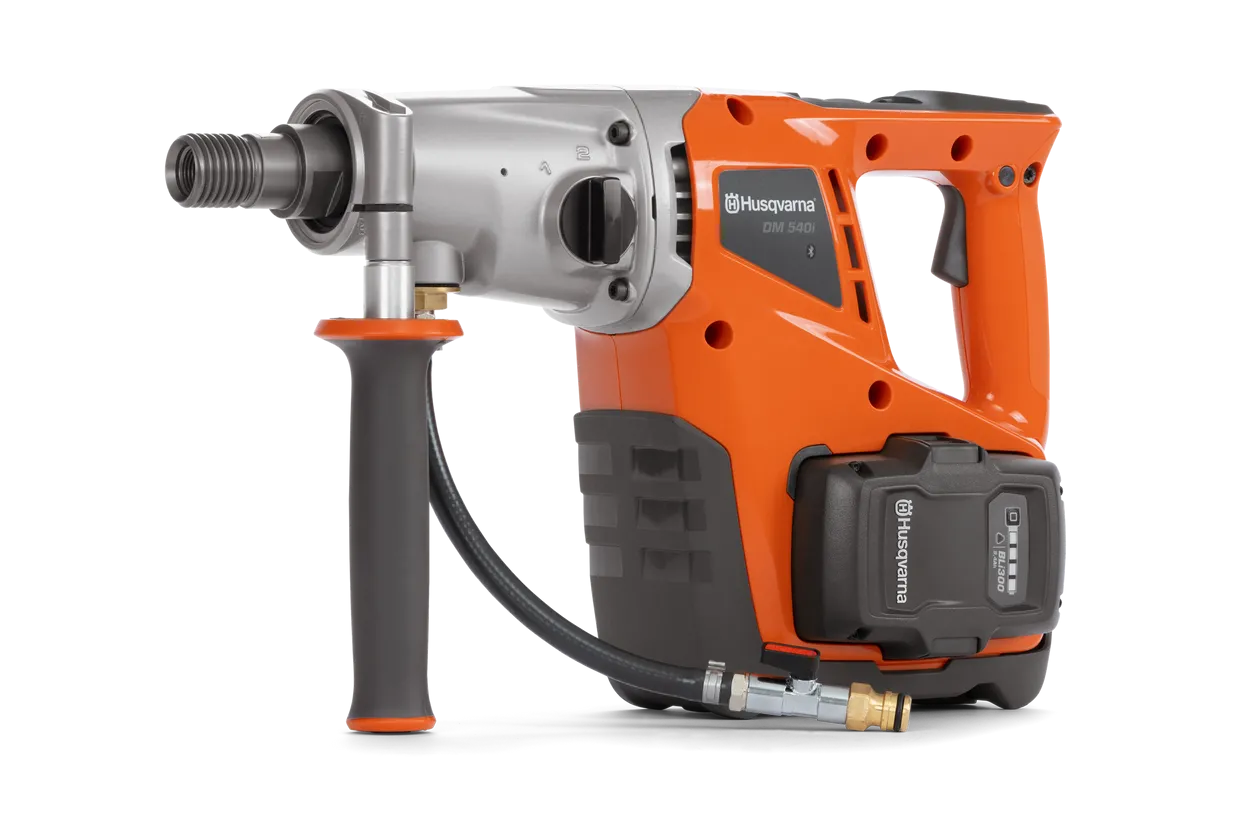
Cordless handheld
Husqvarna DM 540i
Up to 3 in. handheld · Up to 4 in. with DS 150 stand
View product at TDUSA →The Husqvarna DM 540i cordless handheld core drill is a candidate for plumbers, electricians and installation crews making intermittent penetrations where routing a power cord is inconvenient.
Husqvarna specifies up to 3 inches handheld and 4 inches with the DS 150 stand. It identifies brick, lightweight block and light reinforced concrete among its applications, with wet or dry operation using the appropriate equipment.2
Choose it when mobility has real value and a battery-and-charger plan covers the workload. Include water supply or dust extraction in that plan. Removing the power cord does not remove those requirements.
Husqvarna DM 220: Corded versatility with stand capability
Corded handheld + stand option
Husqvarna DM 220
3-speed gearbox · 80 mm / 3 in. handheld · 150 mm / 6 in. mounted maximum
View product at TDUSA →The DM 220 deserves consideration when dependable electrical power is available and the work includes both handheld holes and occasional larger mounted penetrations.
Its D-handle and electronic level indicator help the operator control the tool and maintain the intended drilling angle. Its three-speed gearbox provides operating choices for different bit sizes. The manual lists the DS 250 as a stand accessory, making this a documented route to mounted operation. Select the gear and drilling mode together; the manual does not recommend first gear for handheld drilling.1
This is a useful option for a contractor who values flexibility but does not need cordless operation.
Shibuya HH1531 ABV Combo: Buy for both operating modes

Combination system
Shibuya HH1531 ABV Combo
Handheld and mounted applications · 3-speed motor
View product at TDUSA →TDUSA’s Shibuya HH1531 ABV Combo is worth comparing when both handheld and stand-mounted drilling are part of the expected workload.
Shibuya documents the HH1531 motor with a TS-165 stand as a combination intended for both modes, with a three-speed gearbox.3
The purchasing advantage is considering the motor and mounting arrangement together. Confirm the supplied U.S. configuration, mode-specific capacity and accessories with TDUSA. The package’s mounted capacity should never be treated as permission to use the same diameter handheld.
Husqvarna DMS 240: A dedicated rig for regular coring
Dedicated motor and stand
Husqvarna DMS 240
10 in. maximum diameter · 0–60° column adjustment
View product at TDUSA →The Husqvarna DMS 240 core drill system is a candidate when mounted drilling is the normal job.
Husqvarna lists a 10-inch maximum drilling diameter and 0–60-degree column adjustment. The system combines a drill motor and stand, with transport wheels and an integrated vacuum base.4
Consider it for recurring pipe, ventilation and other service penetrations that justify a dedicated rig. Check site power before ordering: the current manual specifies 20 amps for the 100–120 V version.5
Shibuya TS-255 PRO ABV: Another dedicated-rig option

Dedicated mounted system
Shibuya TS-255 PRO ABV
2-speed H2021 motor · Confirm column, spacer and package contents
View product at TDUSA →The Shibuya TS-255 PRO ABV belongs on the comparison list for contractors buying a dedicated mounted system for a range of core sizes.
Shibuya documents the TS-255/H2021 with a two-speed motor, overload protection and multiple column configurations. Its published maximum-capacity specification also identifies a required spacer, demonstrating why the motor name alone is insufficient to establish system capacity.6
Choose the package around the required hole diameter, usable travel, mounting method and available electrical service. Confirm the included spacer, column and vacuum equipment before comparing package prices.
HYCON hydraulic handheld drills: Specialized access and existing hydraulic equipment
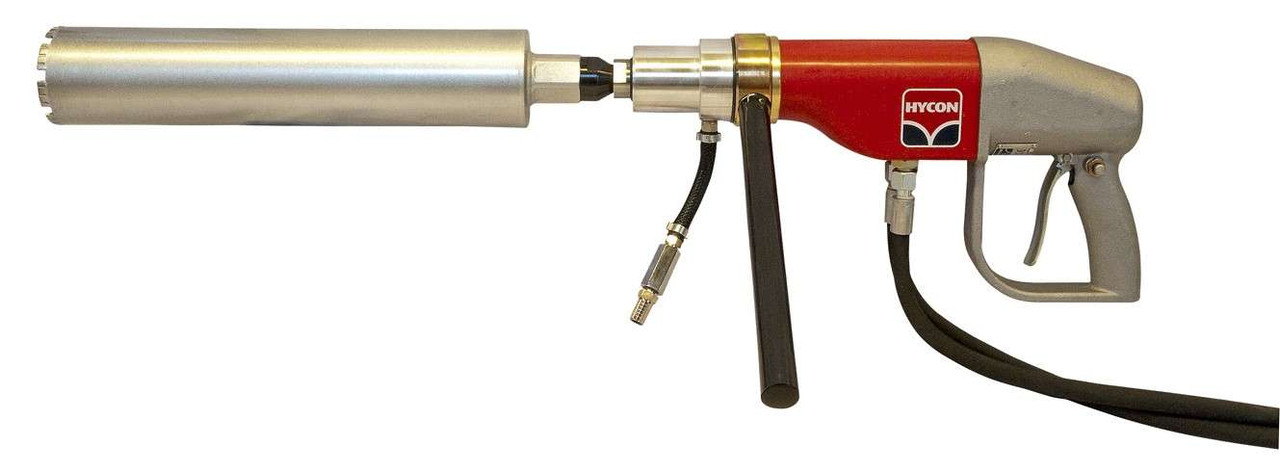
Hydraulic handheld options
HYCON hydraulic handheld core drill
Separate hydraulic source · Confirm the exact supplied model
View product at TDUSA →TDUSA’s HYCON hydraulic handheld core drill options deserve consideration for difficult-access work or crews that already operate a compatible hydraulic source.
HYCON documents handheld and rig-mounted use. Its HCD50-200 product sheet specifies a 60 mm mounting front, 600 rpm maximum speed and 20 L/min oil flow, listed as 5 GPM. A suitable rig can therefore remain part of the selection discussion.7
The justification is the application and complete hydraulic setup. Confirm the exact supplied model, permitted bit range, source requirements and mounting hardware with TDUSA. HYCON’s larger-diameter claims include qualifications, so they should not become a blanket handheld recommendation.
For a fuller discussion of power-source tradeoffs, see TDUSA’s handheld hydraulic tools comparison.
Choose the mounting method before buying the rig
An anchor base needs a suitable substrate and correctly selected fastening system. TDUSA offers core-drill anchor systems to include in the purchase.
Vacuum mounting needs a surface that can maintain a reliable seal, along with the specified pump, gasket and operating vacuum. Do not assume that a vacuum base is approved for walls or ceilings. Husqvarna’s vacuum-plate instructions, for example, expressly prohibit those applications for that accessory.8
Also distinguish a vacuum base from a complete vacuum package. Verify what is included before placing the order.
Match the bit and supporting equipment
Wet versus dry drilling is a separate choice from handheld versus mounted operation. Select a diamond core bit for the material, diameter, depth and approved drilling method.
Check the spindle connection, required operating speed and available clearance. An adapter may connect two components without making the resulting combination suitable for the job.
For wet drilling, include the necessary water-management equipment. For dry drilling, use the specified extraction equipment. Husqvarna’s DM 540i manual requires dust extraction for dry operation and specifically excludes a household vacuum as the substitute.9
Common questions about handheld and rig-mounted core drills
Can the same core drill be used handheld and on a stand?
Yes, if the manufacturer approves both operating modes and the specific stand connection. For example, the Husqvarna DM 220 manual lists the DS 250 stand accessory. Check the permitted diameter and operating instructions for each mode before buying; a motor’s mounted capacity is not its handheld capacity.
Is there one maximum hole size for all handheld core drills?
No. The handheld limit depends on the exact drill and application. The DM 220 manual lists 80 mm / 3 inches handheld and 150 mm / 6 inches with a stand. Use the model-specific handheld rating, rather than the largest capacity advertised for the motor.
Does using a rig mean you must drill wet?
No. Wet versus dry drilling is a separate selection from handheld versus mounted operation. Match the drill, diamond core bit and water-management or dust-extraction equipment to the material and manufacturer-approved method.
Compare your options
Find your next core drilling setup
Product photos from Tools Direct USA. Photos illustrate the listed products; confirm the selected package’s included equipment before ordering.
Get a setup matched to your actual work
Before ordering, give TDUSA the material, required hole diameter and depth, drilling direction, number of holes, available power and proposed mounting surface. Include any motor, stand, bits or hydraulic equipment you already own.
Those details determine whether the practical purchase is a handheld drill, a combination package or a dedicated rig. They also help identify the accessories needed to put it to work.
Contact Tools Direct USAOr call 866-268-2600
Manufacturer references
- Husqvarna DM 220 operator’s manual
https://www.husqvarnaconstruction.com/hcp/tdrdownload/pub000091633/doc000218228/972270299?httproute=True ↩1 ↩2 - Husqvarna DM 540i specifications
https://www.husqvarnaconstruction.com/us/concrete-core-drills/dm540i/ ↩ - Shibuya HH1531 and TS-165 documentation
https://www.shibuya-group.co.jp/en/product/2019-modelstand-ts-165-motor-hh1531/ ↩ - Husqvarna DMS 240 specifications
https://www.husqvarnaconstruction.com/us/concrete-core-drills/dms240/ ↩ - DMS 240 operator’s manual
https://www.husqvarnaconstruction.com/hcp/tdrdownload/pub000079971/doc000222576/1100531477?httproute=True ↩ - Shibuya TS-255/H2021 specifications
https://www.shibuya-group.co.jp/en/product/ts255_h2021/ ↩ - HYCON HCD50-200 product sheet
https://hycontools.com/media/2147/product-sheet-hcd50-200.pdf ↩ - Husqvarna vacuum-plate instructions
https://www.husqvarnaconstruction.com/hcp/tdrdownload/pub000092720/doc000228960/-846113465?httproute=True ↩ - DM 540i operator’s manual
https://www.husqvarnaconstruction.com/hcp/tdrdownload/pub000082470/doc000259206/1288294785?httproute=True ↩