Hydraulic tool selection guide
Handheld Hydraulic Tools vs. Gas, Battery & Corded Electric Tools
Sustained output, point-of-use exhaust, handheld weight, underwater work and an existing hydraulic source can change what “lower cost” really means.

Hydraulic cut-off saw
When are hydraulic tools the better choice?
Handheld hydraulic tools are often the better buy when the work is sustained and demanding, when exhaust cannot be produced at the point of use, when water, slurry or submersion is part of the job, or when a compatible hydraulic source is already on site. They can put high power in a comparatively light tool because the engine or electric motor that creates the power is located in a separate power pack.
Hydraulics are not the best choice for every crew. A gas saw is difficult to beat for occasional cutting in open air when one self-contained tool is the priority. A battery tool can be the most convenient choice for short, mobile work. A corded tool can be economical where suitable power is dependable. But comparing only the purchase price of a hydraulic power pack and tool against the price of a self-contained saw leaves out costs that can change the decision.
Compare the total cost of doing the work under the actual job conditions. Include the power source, hoses or batteries, expected duty cycle, handheld weight, charging or fueling, ventilation, setup, downtime and the number of tools that can share the same power source.
Already know the work you need to do? Contact Tools Direct USA at 866-268-2600. Tell us the tool, material, required cut or hole, expected run time, work environment and any hydraulic source already available. We will check the tool, power source, hoses and other system requirements.
Which power system fits the job?
| Job condition | Usually the strongest candidate | Why | Check before buying |
|---|---|---|---|
| Repeated heavy cutting, breaking, drilling or pumping | Hydraulic | High continuous output at the tool; the prime mover is separate; one source can power several compatible tools in sequence | Required flow, pressure, return pressure, cooling, hoses and couplers |
| Basement, vault, tunnel or other exhaust-restricted work | Electric-powered hydraulic, corded electric or battery | No combustion exhaust at the tool | Available electrical service, water exposure, dust control, ventilation and site rules |
| Open-air, occasional work far from power | Gas | Self-contained and quick to deploy | Fuel, maintenance, noise, exhaust and handheld weight |
| Short-duration mobile work | Battery | Fast setup and no cord, hose or point-of-use exhaust | Real workload per charge, battery inventory, charger capacity and available power |
| Existing excavator, skid steer, backhoe or other compatible hydraulic power source | Hydraulic | The machine may eliminate the need to buy a separate power pack | The complete hydraulic specification; a Hydraulic Flow Divider may be needed |
| Submerged work | A model specifically approved for underwater use | Hydraulic hand tools are available in dedicated underwater versions | Exact model number, manual, hose configuration, diver procedure and permitted location of the power source |
| Two hydraulic tools must operate at the same time | A multi-output power pack sized for both tools | Independent outputs can supply two compatible low-flow tools | Add both tools' flow requirements; a single standard output cannot be counted twice |
This table is a screening guide, not a substitute for the tool and power-source manuals or a jobsite hazard assessment.
How do handheld hydraulic tools work?
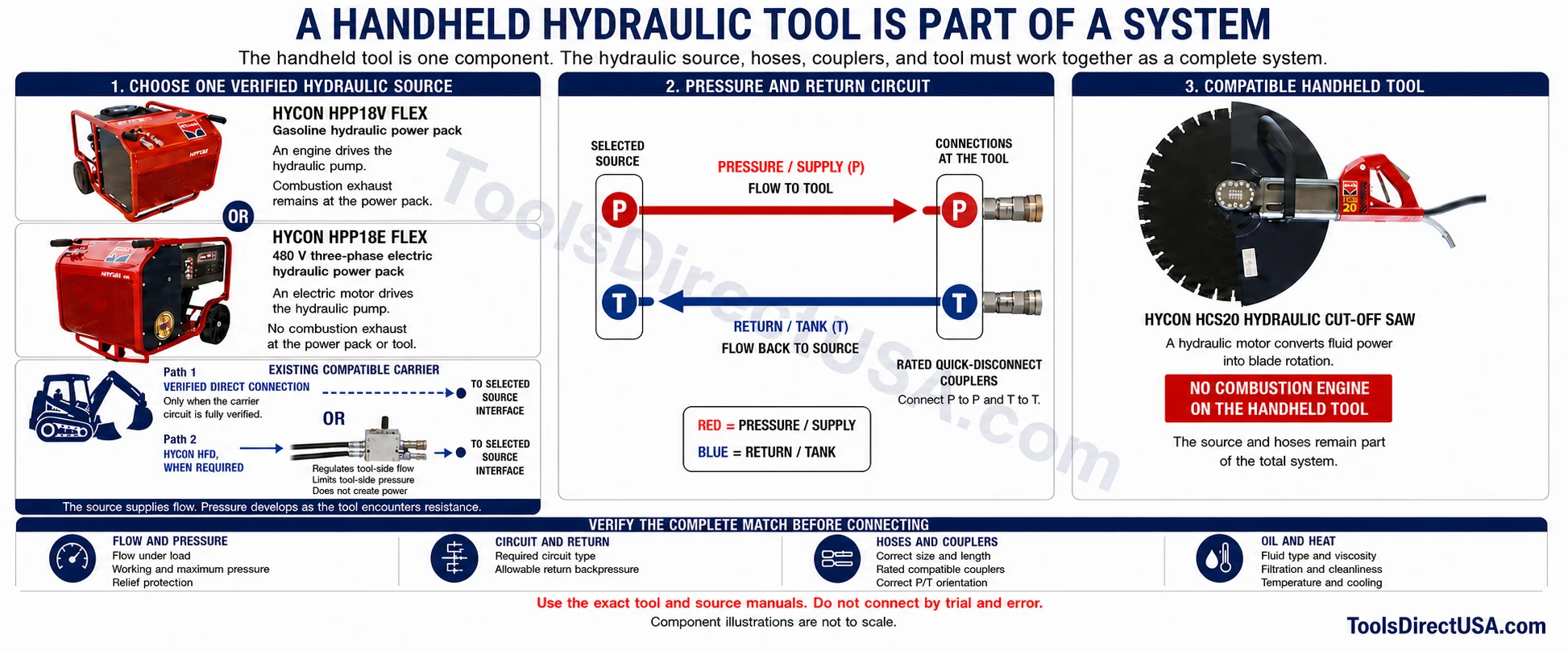
“Hydraulic” describes how power is transmitted, not what originally creates it. A power pack can use a gasoline engine or an electric motor to drive a hydraulic pump. An excavator or skid steer (using a hydraulic flow divider) can provide the oil flow instead. Hoses carry pressurized fluid to the hand tool and return it to the source.
This arrangement has two consequences:
- The tool can be compact because its prime mover, fuel and much of the heat are elsewhere.
- The complete hydraulic system is not necessarily small or inexpensive. It includes a suitable hydraulic power source, supply and return hoses, couplers and sometimes a flow divider or other adapters.
Rotary tools such as cut-off saws, ring saws and drills generally use a hydraulic motor. Breakers instead use hydraulic pressure and flow to cycle an impact mechanism. In either case, flow and pressure must stay within the manufacturer's specification.
The operator may carry a relatively light tool, but the complete system still includes the power source and hoses.
What are the advantages of handheld hydraulic tools?
The main advantages are sustained output, no combustion exhaust at the tool, high power in a manageable tool, options for wet or underwater work, compatibility with existing hydraulic carriers, shared power sources and fewer tool-side service items.
1. Sustained heavy work
Modern battery tools can deliver plenty of peak performance. The more revealing questions are how much force, torque or impact the tool can sustain under a demanding load, how long it can maintain that output and what happens when batteries discharge or the tool reaches a thermal limit.
A properly matched hydraulic system continuously supplies oil at a specified flow and pressure. That can let a hydraulic tool do more than run longer: it can keep working hard through sustained cutting, breaking, drilling or pumping instead of requiring the crew to conserve output for the sake of runtime. It can also reduce stops for refueling a hand-carried engine or changing and cooling batteries.
2. No combustion exhaust at the tool
A hydraulic tool does not contain a combustion engine. That matters in basements, utility vaults, some excavations and other locations where exhaust near the operator is unacceptable.
OSHA uses a fatal closed-in-space incident involving a gasoline concrete saw to illustrate the carbon-monoxide hazard and says a hydraulic or pneumatic saw should have been used instead. A gasoline hydraulic power pack still produces carbon monoxide, however. It must be located and operated where its exhaust cannot enter the work area or an air intake. An electric hydraulic power pack avoids combustion exhaust at both the tool and the pack.
Changing the tool does not cancel other requirements. Employers remain responsible for ventilation, atmospheric testing when required, silica controls, hearing protection and the rest of the job-specific safety plan.
3. High power in a manageable tool
Hydraulic power transmission can deliver substantial torque from a compact motor, giving hydraulic tools the highest powered weight ratio: more power at the tool with less weight in the operator's hands. The benefit is especially clear when a tool must be held horizontally, brought into a trench or repositioned repeatedly.
For example, the HYCON HRS400 ring saw is specified by the manufacturer at 10.2 kg (22.5 lb) without hose or blade, with a 400 mm blade and a maximum cutting depth of 300 mm (11.8 in). The separate power source and hoses still have to be moved and managed, so tool weight should not be confused with total transported weight.
4. Water, slurry and dedicated underwater work
Hydraulic hand tools do not place a battery or line-voltage motor in the operator's hands. Because no electricity powers the tool itself, there is no electrical-shock hazard from the tool when it is operated in damp or wet environments. Many hydraulic tools are designed for wet, dirty work and are well suited to utility repair, dewatering and wet concrete cutting.
Wet cutting does not make a tool suitable for underwater use. HYCON lists separate topside and underwater versions of several saws, drills and breakers. Do not submerge a standard model simply because it tolerates water or uses hydraulic drive. Confirm the exact item number and follow the underwater model's manual and diving procedures. Keep the power pack and every electrical connection in the location permitted by their own instructions.
The HYCON HWP3 hydraulic trash pump is a different case: it is a purpose-built submersible pump. Tools Direct USA lists it at up to 370 GPM and 65 ft of head with a required hydraulic flow of 5–8 GPM. Actual pump output varies with head, hose and system conditions.
5. An existing hydraulic carrier can change the economics
If a backhoe, skid steer, excavator or other machine is already on the job, it may be able to power a handheld tool. This can eliminate the cost and transport of a separate power pack.
The HYCON Hydraulic Flow Divider regulates output flow, limits tool-side pressure with a relief valve and helps ensure correct flow direction. By preventing excessive flow and pressure from reaching the tool, it can also help protect the tool's seals from failure. It does not create power; the carrier supplies the energy. The HFD comes with orifices for selectable tool output of 5, 8 or 10 GPM. A 12 GPM orifice is available separately, allowing the divider to support 5, 8, 10 or 12 GPM, subject to the limits on both the incoming circuit and tool output.
Running the carrier at full throttle does not make the connected tool work faster once the HFD is supplying its required flow. The divider sends only the selected flow to the tool, while excess carrier flow is converted into heat, wasting fuel and potentially increasing hydraulic temperature. Follow the carrier and HFD instructions and use the lowest engine speed that reliably maintains the tool's specified flow and pressure instead of assuming that full throttle is better.
HYCON Flex power packs apply the same use-only-what-the-tool-needs principle. On the HPP18V Flex, the approximate 5, 8 and 10 GPM settings correspond to engine speeds of 1,800, 2,700 and 3,600 rpm. Matching the flow setting to the tool instead of running the pack at maximum rpm can reduce fuel consumption, extend operating time between refills and keep the crew working longer. Always select the tool manufacturer's required flow rather than simply choosing the lowest setting.
Some machines can connect directly if the circuit is fully verified and adjusted to the tool manufacturer's requirements. “The machine has auxiliary hydraulics” is not enough. Confirm open- or closed-center compatibility, flow under load, working and maximum pressure, relief setting, return pressure, oil temperature, filtration, viscosity, coupler type, hose size and correct pressure/return orientation. Use a flow divider when the source is excessive, variable or otherwise not verified for direct connection.
6. One power source can support a tool platform
Your first hydraulic setup costs more because it establishes the source and hose infrastructure. The next compatible tool can cost far less than another complete power system.
A utility or concrete crew might use the same correctly sized power pack and hose set with a cut-off saw, breaker, trash pump and core drill, normally one tool at a time. The relevant purchase is no longer just one saw. It is a power system that may serve several tools for years.
Do not assume that one outlet runs multiple tools simultaneously. A standard single-circuit pack supplies one tool at a time. The HPP18V MultiFlex can run two independent tools at up to 5 GPM each, or one higher-flow tool up to 10 GPM. Two 8 GPM tools do not fit that two-tool mode.
7. Fewer service items can lower lifecycle cost
Hydraulic oil continuously circulates through the tool, lubricating internal components and carrying heat back to the power source, where the system's cooler rejects it. Direct-drive hydraulic tools also avoid many of the service items found on engine-driven equipment, such as carburetors, spark plugs, clutches and, in some designs, drive belts. Fewer wear and service items can reduce maintenance labor, consumable costs and downtime over the tool's working life.
The complete system still requires maintenance. Crews must inspect hoses and couplers, maintain clean hydraulic oil, replace filters and service the engine when using a gasoline or diesel power pack. The economic advantage is therefore lower and more centralized maintenance, not a maintenance-free system.
Deep-cutting clarification: Hydraulic ring and concrete chain saws can make much deeper handheld cuts than conventional center-arbor cut-off saws. That advantage comes primarily from the ring or bar-and-chain design, not from hydraulic power itself. Gasoline and high-frequency electric ring saws also exist, so compare ring saws with ring saws and chain saws with chain saws.
One source can support several compatible tools


Product photography sourced from the linked Tools Direct USA product pages.
Tools Direct USA system starting points
The configurations below cover common applications. They are not preapproved packages for every job. Blades, bits, chisels, discharge hose, conversion hoses and some couplers are sold separately. Tools Direct USA should verify the final combination before order.
General utility and municipal crew: HPP14V Flex
The HYCON HPP14V Flex power pack provides selectable 5 or 8 GPM flow at up to 2,200 PSI. Tools Direct USA lists a 14 hp Vanguard gasoline engine and 179 lb operating weight.
It can power compatible 5–8 GPM tools such as:
- HCS hydraulic cut-off saws, depending on blade size and selected flow;
- HH20RV all-round breaker at 5 GPM; and
- HWP3 trash pump at 5–8 GPM.
This is a gasoline pack. Place and operate it where the engine exhaust cannot contaminate the work area.
Higher-flow cutting: HPP18V Flex
The HYCON HPP18V Flex supplies selectable 5, 8 or 10 GPM at up to 2,300 PSI. It fits tools such as the HRS400 ring saw, which requires 8–10 GPM, while also supporting lower-flow compatible tools.
The pack is specified at approximately 232 lb and remains a one-tool-at-a-time source. Select the flow required by the connected tool; more flow is not automatically better and can overspeed or damage a tool.
Indoor production where 480 V three-phase power is available: HPP18E Flex
The HPP18E Flex electric power pack provides 5, 8, 10 or 12 GPM without combustion exhaust. Tools Direct USA lists the U.S. version for 480 V, three-phase service at 25 A and a maximum pressure of 2,300 PSI. The suggested minimum generator size for the HPP18E is 30kW.
For plants, industrial facilities and long-duration indoor work, this pack avoids combustion exhaust. It requires the specified three-phase electrical service. Have a qualified person verify the service, connection, overcurrent protection and site requirements.
Two low-flow tools at once: HPP18V MultiFlex
Choose the HPP18V MultiFlex when simultaneous use is a real requirement. It can provide two independent circuits at 3, 4 or 5 GPM per tool, or combine output for one tool at 3, 4, 5, 8 or 10 GPM. Size the proposed pair explicitly.
Existing carrier: Hydraulic Flow Divider or verified direct connection
When a compatible carrier is already present, start with its hydraulic documentation and a measured circuit test before selecting adapters. Tools Direct USA can help determine whether the Hydraulic Flow Divider, a direct connection, conversion hoses or other components are appropriate.
How much does a handheld hydraulic tool system cost?
A complete portable hydraulic system usually costs more initially than one self-contained gas or battery tool. The economics can improve when a compatible hydraulic source is already available or several tools share the same source.
The examples below use Tools Direct USA online prices checked August 19, 2026. They exclude blades, bits or chisels, taxes and any job-specific adapters. Product prices and availability change; follow each link for the current price.
| Example system | Included | Price snapshot |
|---|---|---|
| Dedicated 14 hp hydraulic cut-off system | HPP14V Flex ($5,748.75) + HCS14 option ($2,413.32) + 25 ft hose set ($570.38) | $8,732.45 |
| Cut-off system using an existing compatible carrier | Hydraulic Flow Divider ($891.00) + HCS14 option ($2,413.32) + 25 ft hose set ($570.38) | $3,874.70, before carrier-specific conversion components |
| Higher-flow hydraulic ring-saw system | HPP18V Flex ($7,602.00) + HRS400 ($4,790.00) + 25 ft hose set ($570.38) | $12,962.38 |
| Illustrative battery cut-off setup | Husqvarna K1 PACE 14 in. saw ($1,599.00) + two B750X batteries ($1,714.00) + C900X charger ($519.00) | $3,832.00 |
For comparison, Tools Direct USA listed a 14 in. Husqvarna K770 gas cut-off saw from $1,269 and a Husqvarna K970 gasoline ring saw at $5,059 on the same date. The numbers show that:
- A new dedicated hydraulic system costs substantially more at the outset.
- That difference can shrink when a compatible source is already owned, and the economics can improve as more tools share the source.
The battery example does not claim equivalent runtime. Two batteries may be too few, sufficient or more than enough depending on the cut, material, blade, feed and charging opportunity. A saw-only price does not represent the complete battery setup. A hydraulic tool price does not represent the complete hydraulic setup either.
Use total cost per productive hour, not sticker price alone
Build the comparison from these costs:
Annual ownership cost
= purchase price spread over expected service life
- financing
- scheduled service and wear items
- batteries expected to be replaced
- hoses, couplers and fluid service
- fuel or electricity
- expected repair cost
Then estimate:
Cost per productive hour
= annual ownership and operating cost
÷ hours the tool is actually available and producing required work
Add labor cost for refueling, charging, battery changes, moving the source, hose setup, ventilation controls and avoidable downtime. Use the crew's own records whenever possible; a generic “hydraulics saves X percent” claim is less useful than a calculation using that crew's utilization and labor rate.
What hydraulic flow, pressure and connections does a tool require?
A hydraulic tool requires a source that matches its specified flow, working and maximum pressure, return pressure, circuit type, fluid, cooling, hoses and couplers. Verify all of the following before connecting the tool:
- Flow: What flow does the tool require, and can the source maintain it under load? Excess flow can overspeed a motor or blade.
- Working and maximum pressure: Working pressure is not a target to exceed, and a maximum rating is not a normal operating setting. Verify relief protection.
- Return pressure: High backpressure (caused by long hose runs) can damage seals or change tool behavior even when supply pressure looks acceptable.
- Hose size and length: Longer runs create pressure loss and heat. Use the manufacturer's sizing rules. Tools Direct USA's hydraulic hose sets offer different diameters for longer runs.
- Couplers and direction: Match rated, compatible couplers and connect pressure to pressure and return to return. Never defeat a check valve or force incompatible fittings together. Never have more than 2 hose sets (3 couplers) per run.
- Oil condition: Verify fluid type and viscosity, filtration and allowable temperature. Clean oil is part of the tool's life-support system.
- Cooling and reservoir capacity: The source must reject the heat generated during the intended duty cycle.
- Tool mode: Confirm topside versus underwater model and any special procedure.
Before connecting any hand tool to a power pack, obtain the power pack's specification and, when appropriate, test actual flow and pressure with suitable equipment. Never use trial-and-error with a high-pressure tool.
What are the disadvantages of handheld hydraulic tools?
The main disadvantages are the higher initial cost of a complete system, the need to manage a separate power source and hoses, strict compatibility requirements and continued fluid, filter, hose and source maintenance.
When should you choose gas, battery or corded electric tools instead?
Choose gas when the work is outdoors, intermittent and remote, and carrying one self-contained tool matters more than point-of-use weight, exhaust or platform reuse. Tools Direct USA offers cut-off saws, including gas-powered models.
Choose battery when work is short or intermittent, fast deployment is valuable, exhaust is undesirable and the battery-and-charger plan comfortably covers the workload. Browse Tools Direct USA's battery-powered tools. Battery often makes sense when a crew already owns a compatible commercial battery platform.
Choose corded electric, such as the Core Cut C14 Electric Hand Held Saw, when suitable power is dependable, the environment and water controls permit it, and the tool meets the required duty cycle at a lower total cost.
Hydraulics may be a poor fit when the crew cannot manage hoses, has no practical place for the power source, uses the tool too rarely to justify the infrastructure, or lacks personnel able to verify and maintain the system. A powerful tool attached to a mismatched source is not a bargain.
For diamond core drilling, power source is only part of the selection. Our handheld versus rig-mounted core drill guide explains how hole diameter, depth, alignment and mounting requirements affect the choice, with TDUSA equipment options for each setup.
Hydraulic tool safety essentials
Hydraulic tools avoid combustion exhaust and line voltage at the tool, but high-pressure fluid, hoses, noise and cutting or breaking accessories remain hazardous. Safe use depends on correct selection, inspection and operation.
- Follow the exact tool, source and accessory manuals. Observe the required blade, bit or chisel, guards, water supply, flow, pressure and return limits.
- Depressurize the system before connecting, disconnecting or servicing it, following the manufacturer's shutdown procedure.
- Inspect hoses, couplers and fittings before use. Do not use a hand to search for a pinhole leak. High-pressure fluid can penetrate skin; a suspected injection injury requires immediate emergency medical treatment even if the wound looks small.
- Route hoses to reduce trip, abrasion, pinch, traffic and hot-surface exposure. Respect the manufacturer's hose-length and connection limits.
- A jam-control feature can reduce kickback risk; it cannot guarantee that an operator will not be injured. Use the correct stance, two-handed control and prescribed cutting technique.
- Wet cutting can help control respirable crystalline silica, but the employer must use the required engineering controls and exposure plan. Water does not remove blade, slurry, electrical, noise or structural hazards.
- A gas-powered hydraulic pack still creates carbon monoxide. Keep exhaust away from workers, openings and air intakes and follow the job's atmospheric-control requirements.
- Only models explicitly approved for underwater use should be submerged.
Frequently asked questions
Are hydraulic tools more powerful than gas or battery tools?
There is no universal answer. “Hydraulic,” “gas” and “battery” identify power-system types, not a single output level. A properly sized hydraulic tool can provide high sustained power in a compact tool, but useful performance depends on the exact tool, source, accessory and application. Compare rated specifications and demonstrated production for the actual job.
Why are hydraulic hand tools relatively light?
The engine or electric motor that creates power is in a separate power pack or carrier. The tool contains the hydraulic motor or impact mechanism rather than the entire prime mover, fuel supply or large battery. Hoses and the external source remain part of the total system.
Can I run a hydraulic tool from a skid steer or excavator?
Possibly. The auxiliary circuit must match the tool's flow, pressure, return-pressure, circuit, fluid, temperature, filtration, hose and coupler requirements. A Hydraulic Flow Divider can regulate flow, limit tool-side pressure and ensure correct direction when properly selected, but it cannot make an inadequate carrier powerful enough. Ask Tools Direct USA to review the machine and tool specifications.
Do I need a separate power pack?
No. A compatible and properly configured carrier can replace a dedicated pack and may cost less. Some facilities may prefer a stationary or electric hydraulic source. Whatever the source, its compatibility with the tool must be verified.
Can one hydraulic power pack run several tools?
It can power several compatible tools in sequence if its available flow and pressure cover each tool's requirements. Most single-circuit portable packs run one tool at a time. A MultiFlex pack can run two tools simultaneously only within its two-circuit flow limits.
Can every hydraulic tool work underwater?
No. Use only a model specifically identified and approved for underwater operation. Water-resistant topside construction and wet cutting do not establish permission to submerge a tool.
Are hydraulic tools cheaper than gas or battery tools?
The initial complete system is often more expensive than one self-contained gas or battery tool. Hydraulics can become the lower-cost decision when a compatible source already exists, the work is production-intensive, avoiding point-of-use exhaust has operational value, multiple tools share the source, or reduced tool-side maintenance lowers labor and downtime. Calculate cost per productive hour using the crew's real work pattern.
What information should I send Tools Direct USA for a system recommendation?
Send the task and material, blade/bit or required cut dimensions, expected operating time, indoor/outdoor/wet/underwater conditions, number of tools that must run at once, desired hose length and the make/model and hydraulic specifications of any existing carrier. Photos of the work area and the machine's hydraulic data plate or manual are useful.
Get a complete hydraulic system recommendation
Tools Direct USA has supplied specialty construction tools since 2002. We can match the tool, hydraulic source, flow control, hoses and accessories. If hydraulic power is a poor fit for the job, we will say so.
Shop hydraulic equipment, send us the job details or call 866-268-2600, Monday through Friday, 9:00 a.m.–5:30 p.m. Eastern.
Sources and technical references
- HYCON product data: HRS400 ring saw, cut-off saw range, hydraulic power packs, HPP18V MultiFlex, HPP18E Flex, Hydraulic Flow Divider, flow-divider operating guidance and power-source comparison.
- HYCON manuals: HPP18V Flex power pack, HRS400 ring saw and HCS20 cut-off saw.
- Occupational Safety and Health Administration: portable gas-powered equipment and carbon monoxide, excavation requirements and respirable crystalline silica.
- Health and Safety Executive: hydraulic injection injury safety alert.
- National Fluid Power Association: What is fluid power?.
- Husqvarna Construction: K1 PACE battery power cutter, K970 Ring and ring-saw design overview.
Specifications, prices and availability were checked August 19, 2026. The manufacturer's manual and the current Tools Direct USA product page control. This article provides general product-selection information, not engineering, legal or site-safety advice.